
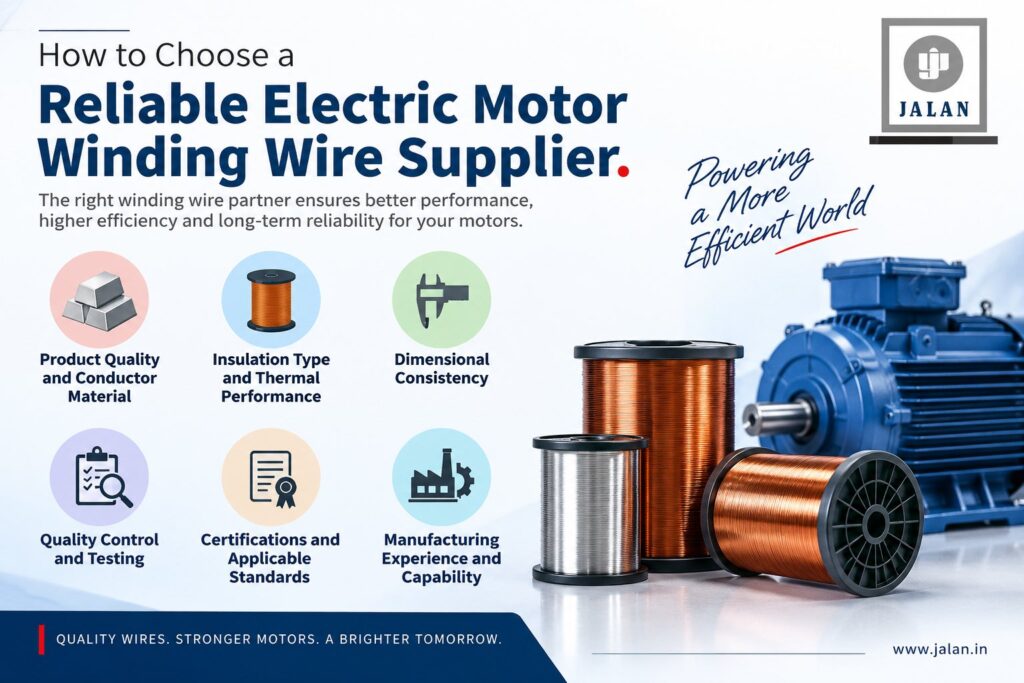
Choosing a reliable electric motor winding wire supplier involves more than comparing prices. Buyers should evaluate conductor material, wire dimensions, insulation type, thermal performance, quality testing, applicable standards, manufacturing capability, delivery reliability, and technical support. The right supplier should consistently provide winding wire that meets the electrical, thermal, and mechanical requirements of the intended motor application.
The quality of winding wire directly affects motor performance, insulation reliability, efficiency, and service life. For motor manufacturers and rewinding professionals, selecting the right supplier can help maintain consistent production and reduce the risk of quality-related failures. Jalan Wires manufactures aluminium winding wire for electric motors, transformers, and other electrical applications, offering products designed for different winding requirements. This guide explains the key factors to consider when choosing a reliable motor winding wire supplier and what to evaluate before placing an order.
What Should You Check When Choosing a Motor Winding Wire Supplier?
When choosing a motor winding wire supplier, evaluate the product quality, conductor material, insulation system, dimensional consistency, testing procedures, applicable standards, manufacturing capability, customisation options, delivery reliability, and technical support. These factors help determine whether a supplier can consistently provide winding wire that meets the electrical, thermal, and mechanical requirements of your application.
Before placing an order, check whether the supplier can provide:
- Suitable conductor material: Confirm that the copper or aluminium conductor matches your motor design and application requirements.
- Consistent wire dimensions: Verify conductor size, insulation thickness, and dimensional tolerances to ensure reliable winding and fit.
- Appropriate insulation: Check the insulation type, thermal performance, and electrical properties required for the application.
- Quality testing and documentation: Ask about testing procedures, inspection records, test certificates, and product specifications.
- Applicable standards and compliance: Confirm that the products are manufactured and tested according to the relevant industry standards and regulatory requirements.
- Manufacturing capability: Evaluate production capacity, quality-control processes, equipment, and ability to maintain consistency across orders.
- Customisation options: Check whether the supplier can provide the required wire dimensions, insulation systems, covering types, spool sizes, or order quantities.
- Delivery reliability: Review lead times, production capacity, inventory availability, and ability to fulfil recurring or bulk orders.
- Technical support: Choose a supplier that can provide product information and technical assistance when selecting the appropriate winding wire.
- Long-term value: Compare quality, reliability, support, delivery performance, and total cost rather than choosing solely on the lowest purchase price.
For motor manufacturers and rewinding professionals, assessing these factors before purchasing can reduce the risk of inconsistent wire quality, production delays, insulation problems, and unnecessary operating costs.
Why Is Winding Wire Quality Important for Electric Motors?
Winding wire quality directly affects the electrical performance, insulation reliability, thermal behaviour, and service life of an electric motor. The conductor must provide consistent electrical characteristics, while the insulation system must withstand the voltage, temperature, mechanical stress, and operating conditions of the motor. Inconsistent wire dimensions or unsuitable insulation can create problems during winding and may increase the risk of insulation damage, overheating, or premature failure.
For motor manufacturers and rewinding professionals, consistent winding wire quality is also important for production reliability. Wire with uniform dimensions and dependable insulation can support accurate winding, predictable electrical performance, and consistent manufacturing results. This is why suppliers should be evaluated not only on price, but also on material quality, dimensional consistency, testing, applicable standards, and manufacturing controls.
Key Benefits of Using Consistent-Quality Winding Wire
- Reliable electrical performance: Consistent conductor properties help maintain predictable electrical characteristics in the motor winding.
- Better insulation reliability: Proper insulation helps protect the conductor against electrical breakdown and operating temperatures.
- Improved thermal performance: The appropriate conductor and insulation system can help the winding withstand the motor’s operating temperature.
- Consistent winding quality: Uniform wire dimensions support accurate winding and help maintain the required winding configuration.
- Reduced quality-related issues: Reliable wire specifications and manufacturing consistency can reduce the risk of problems caused by dimensional or insulation variations.
- Long-term motor reliability: Selecting winding wire that matches the application’s electrical, thermal, and mechanical requirements supports dependable motor operation.
Ultimately, winding wire should be selected according to the motor’s design and operating requirements rather than based on price alone. A reliable supplier should be able to provide consistent product specifications, relevant quality documentation, and technical information to help buyers select the appropriate winding wire for their application.
Key Factors to Consider Before Choosing a Motor Winding Wire Supplier
Choosing a motor winding wire supplier requires more than checking product availability or comparing prices. Buyers should evaluate the wire’s material, insulation, dimensional consistency, quality controls, applicable standards, manufacturing capability, delivery performance, and technical support. Assessing these factors before placing an order can help ensure that the winding wire is suitable for the motor’s electrical, thermal, and mechanical requirements.
1) Product Quality and Conductor Material
- The conductor material is one of the first factors to evaluate when selecting motor winding wire. Copper and aluminium are commonly used conductor materials, and the appropriate choice depends on the motor design, electrical requirements, weight considerations, and application. Buyers should verify the conductor material, dimensions, electrical properties, and consistency against the required specifications.
- The quality of the conductor also needs to remain consistent throughout the supplied wire. Variations in conductor dimensions or electrical properties can affect winding accuracy and motor performance. When evaluating a supplier, check the product specifications, applicable standards, quality documentation, and testing information provided for the winding wire.
- For aluminium winding wire, buyers should also consider whether the supplier offers the required wire form and construction, such as round or rectangular conductors and the appropriate insulation or covering system for the intended application.
2) Insulation Type and Thermal Performance
When selecting motor winding wire, check whether the insulation system is suitable for the motor’s operating voltage, temperature, and environmental conditions. The insulation protects the conductor from electrical breakdown and helps maintain the separation between adjacent turns and other conductive components within the winding.
The required insulation depends on the wire construction and application. Buyers should consider the insulation or covering type, thermal performance, electrical properties, mechanical durability, and compatibility with the winding process. For applications exposed to higher operating temperatures or demanding mechanical conditions, the wire should be selected according to the relevant design and insulation requirements.
Before purchasing, ask the supplier for the applicable product specifications and technical documentation. This helps confirm that the insulation system and thermal performance of the winding wire are appropriate for the intended motor or rewinding application.
3) Dimensional Consistency
Consistent wire dimensions are important for accurate motor winding and reliable electrical performance. Buyers should verify the conductor diameter or cross-sectional dimensions, insulation thickness, dimensional tolerances, and overall wire construction against the required product specification. Even small variations can affect winding fit, available winding space, and the consistency of the finished winding.
A reliable supplier should maintain consistent dimensions throughout the supplied wire and provide clear product specifications for the required size. Before placing a bulk order, confirm the required dimensions and tolerances with the supplier and review the relevant technical documentation or test records. This is particularly important when replacing an existing winding wire during motor rewinding, where the replacement wire needs to meet the required dimensional and insulation specifications.
4) Quality Control and Testing
Quality control and testing help verify that motor winding wire consistently meets its specified electrical, dimensional, insulation, and mechanical requirements. Before choosing a supplier, ask how the wire is inspected and tested, what quality controls are applied during manufacturing, and what documentation is available for the supplied product.
Depending on the wire type and applicable product standard, buyers may need to verify:
- Electrical properties: Check the specified electrical resistance or conductivity of the conductor.
- Dimensional accuracy: Verify conductor dimensions, insulation thickness, and applicable tolerances.
- Insulation performance: Review the relevant electrical and mechanical properties of the insulation or covering system.
- Thermal performance: Confirm that the wire’s specified thermal characteristics are appropriate for the intended application.
- Quality documentation: Ask for relevant test reports, inspection records, certificates, and product specifications where applicable.
- Batch traceability: Check whether the supplier can identify and document the supplied production batch when traceability is required.
A supplier that can clearly explain its quality-control procedures and provide appropriate technical documentation gives buyers greater confidence when evaluating winding wire for new motor manufacturing or rewinding applications.
5) Certifications and Applicable Standards
When choosing a motor winding wire supplier, verify that the supplier follows the applicable quality-management, product, and regulatory requirements for the wire you are purchasing. Certifications and compliance documentation can provide evidence of the supplier’s quality-management practices and help confirm that the product is manufactured and evaluated according to relevant requirements.
Before placing an order, check:
- Quality-management certification: Ask whether the supplier operates under a recognised quality-management system, such as ISO 9001, and verify that the certification is current and applicable to the relevant manufacturing operations.
- Applicable product standards: Confirm which IEC, national, or industry standards apply to the specific winding wire and whether the supplier’s products are manufactured and tested accordingly.
- Regulatory compliance: Where required for your market or application, verify relevant requirements such as RoHS or REACH and request supporting documentation.
- Product documentation: Review technical datasheets, specifications, test reports, certificates, and other documents relevant to the product.
- Certification validity: Check that certificates and compliance documents are current and correspond to the supplier, product, or manufacturing scope being claimed.
6) Manufacturing Experience and Capability
A supplier’s manufacturing experience and production capability can affect the consistency, availability, and suitability of motor winding wire. An experienced manufacturer should understand the requirements of different winding-wire constructions and have established