
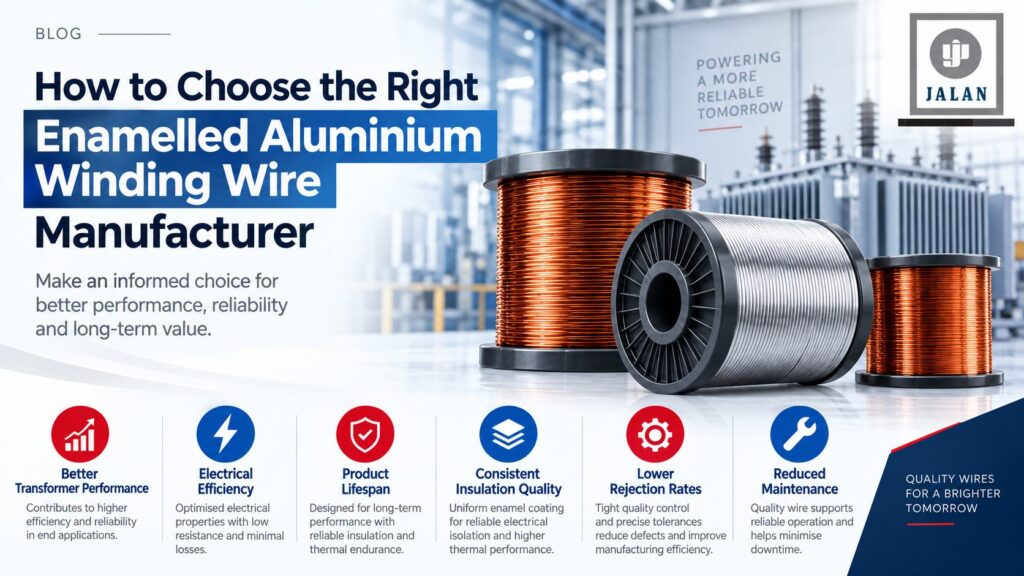
For transformers, motors, generators, and other electrical equipment, the quality and specification of enamelled aluminium winding wire can influence electrical performance, insulation reliability, thermal behaviour, and service life. Choosing the right manufacturer is therefore important for ensuring that the wire meets the electrical, dimensional, insulation, and application requirements of the equipment.
Jalan Wires manufactures aluminium winding wire, including enamelled aluminium wire in round and rectangular forms, for applications such as transformers, motors, and other electrical equipment. This guide explains the key factors to evaluate when choosing an enamelled aluminium winding wire manufacturer, from conductor material and insulation quality to manufacturing capability, testing, standards, delivery, and overall value.
Why Choosing the Right Manufacturer Matters
Choosing the right enamelled aluminium winding wire manufacturer can affect the consistency, insulation performance, and suitability of the wire for transformers, motors, generators, and other electrical equipment. A capable manufacturer should maintain appropriate control over conductor material, wire dimensions, insulation, manufacturing processes, and product testing to meet the required specifications.
-
-
Electrical Efficiency
-
The conductor’s electrical properties and dimensions affect the resistance and losses of a winding. For aluminium winding wire, buyers should consider the aluminium grade, conductor cross-section, dimensional consistency, and operating temperature when evaluating electrical performance.
-
-
Product Lifespan
-
The service life of winding wire depends on factors including conductor quality, insulation system, operating temperature, electrical loading, and mechanical conditions. Consistent manufacturing and appropriate quality testing help ensure that the wire meets its specified electrical, thermal, and mechanical requirements.
-
-
Lower Rejection Rates
-
Manufacturers with robust quality control systems maintain tight tolerances for wire diameter, enamel thickness, and surface finish. Every production batch is thoroughly inspected to identify defects before shipment. This reduces the chances of receiving inconsistent or damaged wire, minimises production rejections, and improves manufacturing efficiency for transformer and motor manufacturers.
-
-
Consistent Insulation Quality
-
Uniform enamel insulation is important for maintaining electrical isolation between the conductor and surrounding winding components. Buyers should evaluate insulation thickness, dielectric performance, thermal class or temperature requirements, and other applicable specifications to ensure the wire is suitable for the intended application.
-
-
Reduced Maintenance
-
Winding-wire quality can certainly contribute to reliable operation, but maintenance frequency depends on the entire electrical equipment, loading, cooling, environment, maintenance regime, and operating conditions.
-
-
Better Transformer Performance
-
The quality of winding wire directly affects transformer efficiency, voltage regulation, and thermal stability. Manufacturers that follow stringent production standards deliver enamelled aluminium winding wires with precise dimensions, stable conductivity, and durable insulation
7 Factors to Consider Before Choosing an Enamelled Aluminium Winding Wire Manufacturer
Selecting the right enamelled aluminium winding wire manufacturer requires more than comparing prices. The manufacturer’s quality directly influences the performance, efficiency, and reliability of transformers, motors, generators, and other electrical equipment. Evaluating key manufacturing standards, quality control processes, and industry expertise helps ensure you receive winding wires that deliver consistent electrical performance and long-term durability.
The following are some of the most common factors to consider when choosing an Enamelled Aluminum Winding Wire Manufacturer
-
-
EC-Grade Aluminium
-
The aluminium conductor is a fundamental part of winding-wire performance. Check the aluminium grade, electrical conductivity, conductor dimensions, and applicable specifications to ensure the material is suitable for the intended motor, transformer, generator, or other electrical application.
-
-
Uniform Enamel Insulation
-
The enamel insulation provides electrical isolation around the conductor. Evaluate insulation thickness, dielectric performance, thermal class or temperature requirements, and mechanical properties to ensure the insulation system matches the application’s operating conditions.
-
-
Applicable Standards and Compliance
-
Check whether the winding wire is manufactured and tested according to the standards applicable to the specific product and application. Ask the manufacturer for relevant product specifications, test reports, certificates, and regulatory compliance documentation where required.
-
-
Manufacturing Technology and Process Control
-
Evaluate the manufacturer’s capabilities across processes such as wire drawing, annealing, enamelling, curing, and inspection. Consistent process control is important for maintaining conductor dimensions, surface quality, and insulation consistency across production.
-
-
Quality Testing and Inspection
-
Ask how the manufacturer verifies product quality and what documentation is provided. Depending on the product and applicable standard, relevant checks may include conductor dimensions, electrical resistance or conductivity, insulation properties, dielectric strength, surface condition, adhesion, flexibility, and thermal performance.
-
-
Production Capacity and Delivery Reliability
-
Confirm that the manufacturer can consistently supply the required wire sizes, specifications, and order quantities within the expected lead time. Production capacity and reliable delivery are particularly important for OEMs and businesses with recurring or bulk requirements.
-
-
Industry Experience and Technical Capability
-
Consider the manufacturer’s experience with aluminium winding wire and its understanding of different electrical applications. Technical capability is particularly valuable when you require specific conductor dimensions, insulation systems, product documentation, or application-related guidance.
-
-
Pricing and Long-Term Value
-
Evaluate price alongside product quality, consistency, testing, delivery, technical support, and overall suitability. The lowest quotation may not represent the best value if the product does not consistently meet the required specifications or creates additional procurement and production issues.
Why Choose Jalan Wires as Your Enamelled Aluminium Winding Wire Manufacturer?
Jalan Wires manufactures aluminium winding wire for electrical applications, including enamelled aluminium winding wire for transformers, motors, and other equipment. When evaluating Jalan Wires as a supplier, buyers can consider its product range, available specifications, manufacturing capabilities, quality-control processes, customisation options, and technical support based on their specific application requirements.
-
-
Product Range and Specifications
-
Jalan Wires offers aluminium winding wire in different constructions and configurations for electrical applications. Buyers can review the available conductor dimensions, wire forms, insulation or covering options, and product specifications to select a wire suited to their equipment and winding requirements.
-
-
Manufacturing Capability
-
The manufacturing process for aluminium winding wire involves stages such as wire drawing, annealing, enamelling, and inspection. Buyers should evaluate the manufacturer’s ability to maintain consistent conductor dimensions, surface quality, and insulation characteristics throughout production.
-
-
Quality and Testing
-
Assess quality through relevant product specifications, inspection procedures, test reports, and compliance documentation. Buyers can request the applicable technical information from Jalan Wires to verify that the selected winding wire meets their required electrical, dimensional, and insulation specifications.
-
-
Customisation and Application Requirements
-
Different electrical equipment may require specific conductor dimensions, wire forms, insulation systems, or other product configurations. Discussing these requirements with the manufacturer can help determine whether the available product or a customised specification is appropriate for the application.
-
-
Technical Support
-
Technical information and supplier support can be useful when selecting winding wire for a specific application. Buyers should confirm the required conductor, insulation, dimensions, and applicable standards before placing an order.
FAQs
1. How do I choose the right enamelled aluminium winding wire manufacturer?
Choose a manufacturer based on conductor material, insulation quality, dimensional consistency, applicable standards, quality testing, manufacturing capability, production capacity, delivery reliability, and technical support. The selected manufacturer should be able to provide product specifications and relevant documentation for your application.
2. What should I check before buying enamelled aluminium winding wire?
Check the aluminium grade, conductor dimensions, enamel insulation system, applicable thermal and electrical requirements, dimensional tolerances, testing information, applicable standards, and supplier documentation before purchasing.
3. Why is EC-grade aluminium used for winding wire?
EC-grade aluminium provides the electrical conductivity required for aluminium winding applications. Its suitability should be evaluated together with conductor dimensions, resistance requirements, operating temperature, and the design requirements of the electrical equipment.
4. What is enamelled aluminium winding wire used for?
Enamelled aluminium winding wire is used to form insulated electrical windings in applications such as transformers, motors, generators, pumps, and other electrical equipment. The appropriate wire specification depends on the equipment design and operating conditions.
5. What should I consider when selecting the insulation for aluminium winding wire?
Consider the insulation type, thickness, dielectric performance, thermal class or temperature requirements, mechanical properties, and compatibility with the intended winding process and application.
6. What standards apply to enamelled aluminium winding wire?
The applicable standards depend on the wire type, application, and target market. Buyers should confirm the relevant product standard with the manufacturer and request applicable test reports, certificates, and compliance documentation.
7. How can I verify the quality of enamelled aluminium winding wire?
Review the manufacturer’s product specifications, test reports, inspection documentation, and applicable compliance certificates. Depending on the product specification, important characteristics may include conductor dimensions, electrical resistance or conductivity, insulation properties, dielectric strength, surface condition, and thermal performance.
8. What tests are performed on enamelled aluminium winding wire?
Depending on the product and applicable standard, testing may include conductor resistance or conductivity, dimensional checks, dielectric strength, insulation integrity, surface inspection, adhesion, flexibility, heat shock, and thermal endurance. The exact tests should be confirmed against the relevant product specification.
9. Can enamelled aluminium winding wire be customised?
Customisation may be possible for requirements such as conductor dimensions, wire shape, insulation or covering configuration, and packaging. Buyers should discuss their technical requirements with the manufacturer to determine whether a standard or customised specification is appropriate.
10. How do I compare two enamelled aluminium winding wire manufacturers?
Compare their material quality, product specifications, insulation systems, quality-control procedures, applicable standards, manufacturing capability, testing documentation, production capacity, delivery reliability, technical support, and total cost rather than comparing price alone.
Conclusion
Choosing the right enamelled aluminium winding wire manufacturer requires more than comparing product prices. Buyers should evaluate the conductor material, enamel insulation, applicable standards, manufacturing processes, quality testing, production capacity, delivery reliability, technical capability, and overall value to ensure the wire meets their specific application requirements.
Jalan Wires offers aluminium winding wire for electrical applications, including enamelled aluminium wire for transformers, motors, and other equipment. Before purchasing, buyers should review the relevant product specifications and technical documentation to confirm that the selected winding wire matches their electrical, dimensional, insulation, and operating requirements.