
What Makes a High-Quality Aluminium Winding Wire?
A high-quality aluminium winding wire should be manufactured using EC-grade (Electrical Conductivity Grade) aluminium, which offers excellent electrical conductivity and efficient current flow. It should also have a durable and uniform enamel insulation coating that protects the wire from electrical short circuits, moisture, heat, and mechanical damage. In addition, the wire must have precise dimensional accuracy, including consistent diameter and insulation thickness, to ensure smooth winding, better space utilisation, and reliable performance in motors, transformers, and other electrical equipment.
Another important factor is that the wire should have low electrical resistance, which helps reduce energy losses, improves efficiency, and minimises heat generation during operation. It should also comply with recognised industry standards such as IS (Indian Standards) or IEC (International Electrotechnical Commission), ensuring the product meets strict quality, safety, and performance requirements. Always choose aluminium winding wire from a trusted and experienced manufacturer that follows accurate and high-quality testing procedures. Proper testing guarantees consistent performance, enhanced safety, and long-term reliability, making the wire a dependable choice for demanding electrical applications.
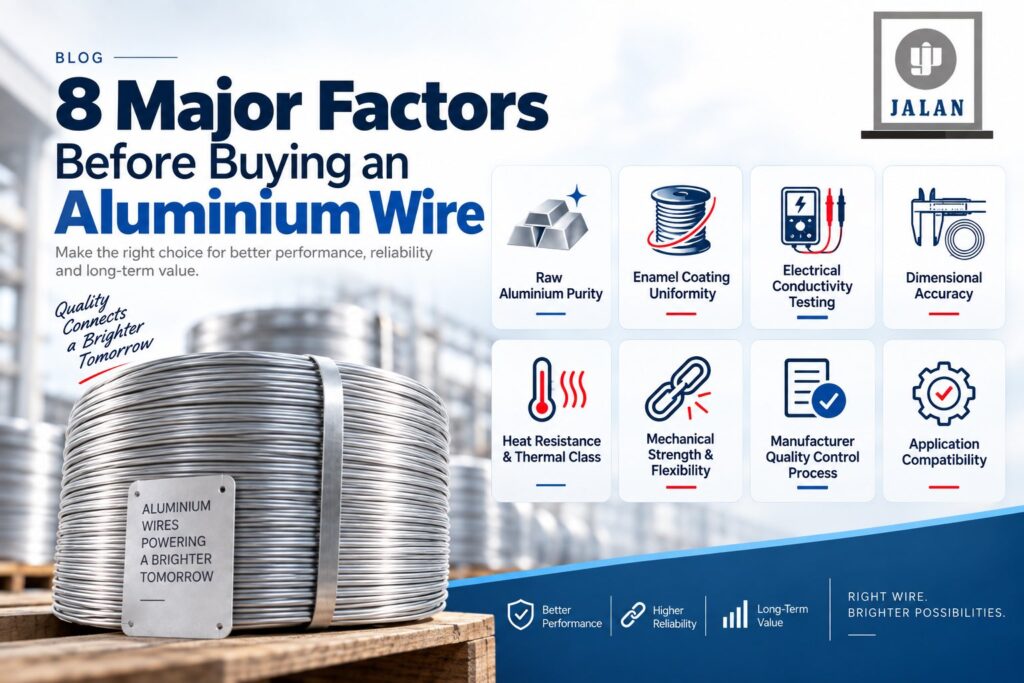
8 Factors for Every Buyer to Check.
When buying aluminium winding wire, focusing only on the price can lead to poor performance, higher energy losses, and frequent equipment failures. To make the right investment, every buyer should evaluate a few essential quality factors before making a purchase
1. Raw Aluminium Purity
The purity of aluminium is one of the most important factors that determines the quality of winding wire. Always choose EC-grade (Electrical Conductivity Grade) aluminium, as it offers high electrical conductivity and better performance. Virgin aluminium is generally a better choice than recycled aluminium because it contains fewer impurities and provides more consistent quality.
Higher conductivity means electricity flows more efficiently with lower resistance, while impurities increase resistance, create more heat, waste energy, and reduce the wire’s lifespan. Choosing high-purity EC-grade aluminium helps ensure better efficiency, reliable performance, and longer service life.
2. Enamel Coating Uniformity
The quality of the enamel coating is just as important as the quality of the aluminium. A good aluminium winding wire should have a uniform insulation thickness to provide consistent protection along its length.
The coating should be pinhole-free to prevent electrical leakage and short circuits, while c enamel protects the wire from damage during winding and installation. It should also have high dielectric strength, allowing it to withstand high voltages without insulation failure. Many premium winding wires use multiple enamel coating layers, which improve heat resistance, durability, and overall reliability, ensuring safe and long-lasting performance in electrical equipment.
3. Electrical Conductivity Testing
The wire should also meet the specified resistance tolerance, ensuring consistent performance across every batch.
Reputable manufacturers use strict quality inspection methods to check conductivity, resistance, and overall wire quality before the product reaches customers, ensuring better efficiency, safety, and long-term reliability.
Electrical conductivity testing helps ensure that aluminium winding wire delivers efficient and reliable performance. A high conductivity percentage allows electricity to flow with less energy loss, while DC resistance testing measures how much the wire resists the flow of current.
4. Dimensional Accuracy
Dimensional accuracy is essential for ensuring aluminium winding wire performs efficiently and fits perfectly during the winding process. The wire should have the correct diameter tolerance, meaning its thickness remains consistent throughout the entire length.
It should also maintain good roundness and minimal ovality (not becoming oval-shaped), allowing smooth and even winding. High-quality manufacturers achieve this through precision drawing processes, which produce accurate wire dimensions, reduce winding defects, and improve the performance and reliability of motors, transformers, and other electrical equipment.
5. Heat Resistance & Thermal Class
Heat resistance is an important factor when choosing aluminium winding wire, especially for motors, transformers, and other equipment that operate at high temperatures. A high-quality winding wire should be able to withstand heat without damaging its insulation, ensuring safe and reliable operation.
Its thermal class indicates the maximum temperature the insulation can safely withstand during continuous use. Even under constant thermal stress, the wire should maintain its electrical performance, insulation quality, and durability, helping extend the life of the equipment and reduce the risk of failure.
6. Mechanical Strength & Flexibility
Mechanical strength and flexibility are essential to ensure that aluminium winding wire withstands the winding process and daily operation without damage. A high-quality wire should have good elongation, allowing it to bend smoothly without cracking or breaking.
It should also have high tensile strength, meaning it can resist breaking when pulled during manufacturing and installation.
Good flexibility makes the wire easier to wind into coils, while strong crack resistance helps protect the insulation and conductor from damage.
These properties improve the wire’s durability, reliability, and overall performance in electrical equipment.
7. Manufacturer Quality Control Process
An aluminium winding wires manufacturer follows a strict quality control process to ensure the reliability of aluminium winding wire. The process begins with raw material inspection to verify the quality of the aluminium, followed by wire drawing to achieve accurate dimensions and annealing to improve flexibility and strength.
The wire is then coated with enamel insulation through the enamelling process, followed by curing and drying to create a durable insulation layer. After this, the wire undergoes quality testing to check its conductivity, insulation, dimensions, and overall performance. Finally, a final inspection is carried out before packaging and dispatch, ensuring that every coil meets quality standards and reaches customers in excellent condition.
8. Application Compatibility
High-quality aluminium winding wire is widely used in distribution transformers, power transformers, electric motors, ceiling fans, and water pumps because it provides efficient electrical performance, reliable insulation, and long service life. Choosing the right wire for the intended application helps improve efficiency, reduce maintenance, and ensure dependable operation.
How to Choose a Reliable Aluminium Winding Wire Manufacturer
Choosing the right manufacturer is just as important as selecting the right aluminium winding wire. Look for a company that uses high-purity EC-grade aluminium, follows strict quality control processes, and complies with IS or IEC standards. A reliable manufacturer should provide consistent product quality, proper testing reports, and durable enamel insulation to ensure long-lasting performance. It is also beneficial to choose an experienced Aluminium winding wires supplier that offers technical support, timely delivery, and a proven track record of serving industries such as transformer, motor, and generator manufacturing. Partnering with a trusted supplier helps ensure you receive high-quality products that deliver reliable and efficient performance.
FAQ’s
1. Where to purchase high-quality aluminium wires?
For reliable quality, consider Jalan Wires, a leading aluminium winding wire manufacturer i n India.
They offer enamelled aluminium wire, bare aluminium wire, and double glass fibre covered aluminium wire.
These products are suitable for transformers, motors, generators, and other electrical applications.
2. Why is EC Grade aluminium preferred for winding wires?
EC-grade (Electrical Conductivity Grade) aluminium is preferred because it offers high electrical conductivity, low resistance, and excellent energy efficiency. Its high purity allows electricity to flow more smoothly, reducing power losses and heat generation. It also provides consistent performance, making it an ideal choice for manufacturing reliable aluminium winding wires used in transformers, electric motors, generators, ceiling fans, and pumps.
3. What is the thermal class of aluminium winding wire?
The thermal class of aluminium winding wire refers to the maximum temperature that its enamel insulation can safely withstand during continuous operation without losing its insulating properties. A higher thermal class allows the wire to perform reliably at higher temperatures, reducing the risk of insulation failure and extending the lifespan of motors, transformers, and other electrical equipment.
4. What is a high-quality aluminium winding wire?
A high-quality aluminium winding wire is made from high-purity EC-grade aluminium and coated with a durable, uniform enamel insulation. It offers high electrical conductivity, low resistance, accurate dimensions, good heat resistance, and strong mechanical properties. It also complies with industry standards such as IS or IEC, ensuring safe, efficient, and reliable performance in transformers, electric motors, generators, and other electrical equipment.
5. What industries use aluminium winding wire?
Aluminium winding wire is widely used in industries that manufacture or maintain electrical equipment. Common applications include power and distribution transformers, electric motors, generators, ceiling fans, water pumps, industrial machinery, renewable energy systems, and electrical appliances. Its lightweight design, good electrical conductivity, and cost-effectiveness make it a preferred choice for many industrial and commercial applications.