
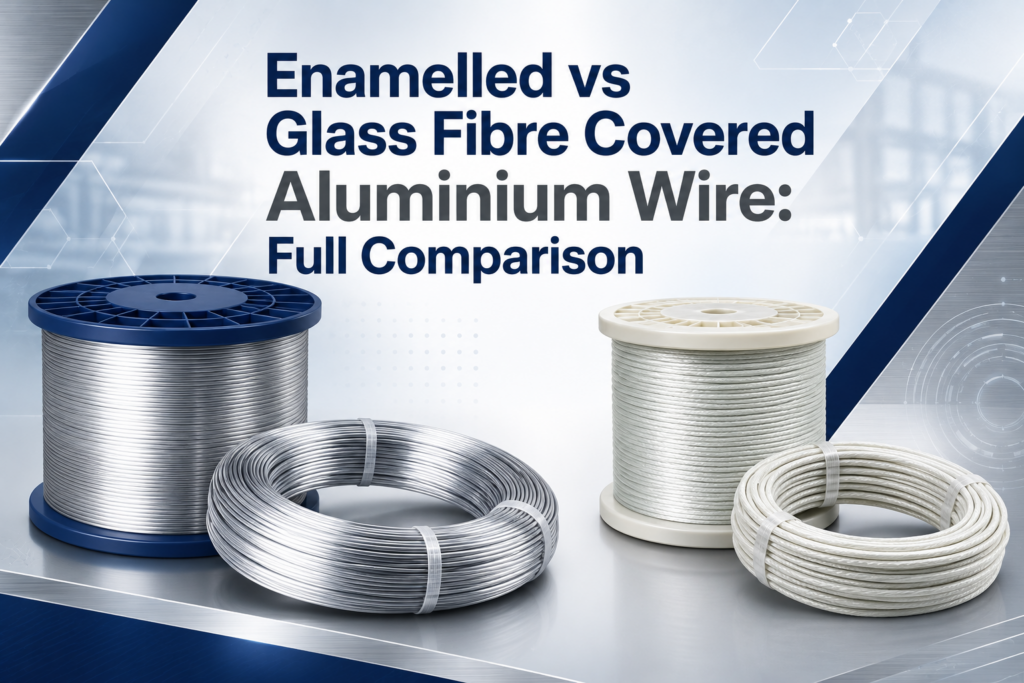
Choosing the right insulation system for aluminium winding wire is one of the most consequential engineering decisions in transformer, motor, and generator design. The two dominant options, enamelled aluminium wire and glass fibre-covered (GFC) aluminium wire, each solve different problems, and specifying the wrong one can lead to premature insulation failure, wasted winding space, or unnecessary cost.
Yet many procurement teams still treat this as a simple price comparison, and many product datasheets blur the lines between what each insulation system actually delivers. This guide cuts through the ambiguity. We compare enamelled and glass fibre-covered aluminium wire across eight measurable performance dimensions, map each to its strongest application fit, and provide a decision framework you can apply to any new winding project.
Head-to-Head Comparison at a Glance
The table below summarises the core differences between enamelled aluminium wire and glass fibre-covered aluminium wire across the parameters that matter most to design engineers and procurement teams.
| Parameter | Enamelled Aluminium Wire | GFC Aluminium Wire |
| Insulation Material | Thermally cured polymer enamel (polyester, polyesterimide, or polyamide-imide) | One or more layers of alkali-free glass fibre braid, often with additional resin impregnation |
| Insulation Thickness | Very thin: ~15–50 µm per side (Grade 1/Grade 2) | Substantially thicker: ~0.15–0.40 mm per side, depending on wrap layers |
| Typical Thermal Class | Class 130 (B) to Class 220 (R) | Class 155 (F) to Class 220+ (R/C), depending on resin system |
| Continuous Operating Temp. | 130–220 °C (enamel-grade dependent) | 155–220+ °C; excels at sustained high-temp operation |
| Mechanical Protection | Moderate — enamel resists normal winding stress but can chip on sharp edges | High — glass fibre braid absorbs abrasion, vibration, and impact during winding and service |
| Dielectric Strength | High — thin enamel delivers excellent volts-per-µm performance | High — combined glass + resin provides robust inter-turn and ground-wall insulation |
| Space Efficiency | Excellent — minimal insulation build maximises conductor fill factor | Lower — thicker insulation reduces available conductor area in a given slot or window |
| Winding Behaviour | Smooth, fast winding; compatible with high-speed automatic winding machines | Slower winding due to higher friction; often requires semi-automatic or hand-winding |
| Cost | Lower — simpler manufacturing process, less material per metre | Higher — glass fibre wrapping and resin impregnation add processing cost |
| Chemical / Moisture Resistance | Good — cured enamel resists oils, solvents, and moisture | Good to excellent — resin-impregnated glass fibre performs well in oil-filled and humid environments |
| Primary Use Cases | Distribution transformers, induction motors, generators, HVAC compressors, and appliances | Dry-type transformers, traction motors, reactors, high-temp generators, heavy industrial motors |
What Is Enamelled Aluminium Wire?
Enamelled aluminium wire is a high-purity aluminium conductor (typically EC-grade 1350, ≥99.5% Al) coated with one or more layers of thermally cured polymer enamel. The enamel is applied as a liquid varnish, then polymerised at 400–550 °C in a vertical curing oven to form a tough, flexible insulating film that bonds directly to the conductor surface.
Because the enamel layer is extremely thin, roughly 15 to 50 µm per side depending on the grade, enamelled wire achieves the highest conductor-to-insulation ratio of any winding-wire type. This makes it the default choice wherever space efficiency, winding speed, and cost are the primary design drivers.
Common Enamel Systems
| Enamel Chemistry | Thermal Class | Typical Applications |
| Modified polyester | Class 130 (B) | General-purpose distribution transformers, small motors |
| Polyesterimide | Class 155–180 (F/H) | IE2/IE3 induction motors, medium-duty generators |
| Polyamide-imide (PAI) | Class 200–220 (N/R) | High-efficiency motors, hermetic compressors, demanding thermal environments |
| Composite (polyester base + PAI topcoat) | Class 200 (N) | Cost-optimised alternative to full PAI for motors and transformers |
What Is Glass Fibre Covered (GFC) Aluminium Wire?
Glass fibre-covered aluminium wire starts with the same EC-grade aluminium conductor but substitutes, or supplements, the enamel layer with one or more wraps of alkali-free glass fibre braid. The glass braid is typically impregnated with a thermosetting resin (silicone, epoxy, or polyester-based) that bonds the fibres together and fills micro-voids, creating a mechanically robust and thermally resilient insulation envelope.
The resulting insulation build is substantially thicker than enamel alone, typically 0.15 to 0.40 mm per side, which reduces the conductor fill factor in a given winding space. However, that thickness is exactly what delivers GFC wire’s defining advantages: superior mechanical protection, outstanding thermal endurance, and robust performance in harsh operating environments.
GFC Insulation Configurations
- Single glass fibre wrap: One layer of glass braid over bare or enamelled conductor. Used for moderate-duty applications requiring extra abrasion resistance.
- Double glass fibre wrap: Two layers providing higher dielectric strength and greater mechanical protection. Common in dry-type transformer and traction-motor windings.
- Enamel + glass fibre combination: Enamel base coat for dielectric strength plus glass overwrap for mechanical and thermal protection. Offers the best of both systems at a higher cost point.
Detailed Parameter-by-Parameter Comparison
1. Insulation Build and Space Efficiency
This is where the two wire types diverge most sharply. Enamelled aluminium wire’s enamel build of 15–50 µm per side means that insulation occupies only a tiny fraction of the total wire cross-section. In a distribution transformer LV winding, that translates into more copper (or aluminium) turns per layer, a higher slot-fill factor in motors, and ultimately a more compact, lighter coil.
GFC wire’s insulation, built up to 0.15–0.40 mm per side, is five to ten times thicker. For the same conductor gauge, GFC wire requires a larger winding window, which can increase transformer core size or motor slot dimensions. In space-constrained designs, such as pole-mounted distribution transformers or fractional-horsepower motors, this penalty is often disqualifying.
Bottom line: If winding space is at a premium, enamelled wire is the stronger choice. If the design already has thermal or mechanical margins that demand thicker insulation, GFC wire’s space penalty is a worthwhile trade-off.
2. Thermal Performance
Both wire types span a wide thermal-class range, but their performance profiles differ at the extremes. Standard polyester enamelled wire tops out at Class 130 (B), while high-grade PAI enamel reaches Class 220 (R), more than adequate for the vast majority of transformer and motor applications.
Glass fibre-covered wire, however, truly excels in sustained high-temperature operation. The glass braid itself is inherently non-combustible and retains its mechanical integrity well above 200 °C. When combined with a silicone resin binder, GFC insulation can deliver Class 220+ performance with a wider thermal safety margin than enamel alone, particularly under thermal cycling, where the rigid enamel film is more susceptible to micro-cracking than the flexible glass braid.
Bottom line: For equipment with hotspot temperatures consistently above 180 °C or subject to severe thermal cycling, such as traction motors, kiln-drive motors, or dry-type cast-resin transformers, GFC wire offers a measurable reliability advantage.
3. Mechanical Strength and Abrasion Resistance
During winding, the conductor is pulled through guides, bent around formers, and pressed against slot liners. In service, it is subject to vibration, thermal expansion, and electromagnetic forces. Enamelled wire handles normal winding stresses well, but its thin film can chip or crack on sharp winding edges, a risk that increases with wire gauge and winding speed.
GFC wire’s braided glass jacket acts as built-in armour. It absorbs abrasion from winding machinery, cushions the conductor against sharp former edges, and resists the vibrational fatigue that affects traction and heavy-industrial motors over thousands of operating hours.
Bottom line: For hand-wound or semi-automatic coils in heavy-duty equipment, GFC wire’s mechanical resilience reduces winding rejects and extends service life. For high-speed automatic winding of distribution transformer or small motor coils, the smooth, low-friction surface of the enamelled wire enables higher throughput with fewer machine jams.
4. Dielectric Strength
On a per-micron basis, cured enamel delivers exceptional dielectric strength, typically 80–120 kV/mm depending on the enamel chemistry. A thin enamel build can therefore provide substantial voltage withstand in a very compact package, which is why enamelled wire dominates in LV windings where inter-turn voltages are moderate.
GFC wire achieves its dielectric performance through sheer insulation volume rather than per-micron efficiency. The combined glass + resin system provides robust ground-wall and inter-turn insulation, and its thickness offers a larger margin for partial-discharge inception voltage, an advantage in HV windings, dry-type transformers, and equipment operating at altitude where the dielectric strength of air is reduced.
Bottom line: For standard LV windings, the high dielectric strength per micron of enamelled wire is more than sufficient. For HV windings, altitude applications, or designs requiring extra partial-discharge headroom, GFC wire’s thicker insulation offers greater margin.
5. Chemical and Environmental Resistance
Cured enamel effectively resists transformer oil, most industrial solvents, and atmospheric moisture, making enamelled aluminium wire well-suited for oil-immersed transformers, hermetic compressor motors (where the enamel must withstand refrigerant exposure), and general indoor environments.
Resin-impregnated glass fibre insulation also performs well in oil-filled equipment and adds an extra degree of moisture resistance in high-humidity or outdoor environments. In applications involving aggressive chemicals, such as motors driving chemical-processing pumps, the thicker GFC barrier provides additional protection against insulation degradation.
Bottom line: Both systems handle standard industrial environments. For extreme chemical or moisture exposure, GFC’s thicker insulation barrier offers an incremental safety margin.
6. Cost and Manufacturing Economics
Enamelled aluminium wire is less expensive to produce: the enamelling process uses less raw material per metre, runs at higher line speeds, and produces a lighter finished product that costs less to transport. For large-volume applications, distribution transformers, fractional-horsepower motors, and appliance coils, the cost difference is significant and compounds at scale.
GFC wire commands a price premium due to the glass fibre material itself, the slower wrapping process, and the additional resin impregnation step. This premium is justified when the application genuinely requires GFC’s thermal or mechanical advantages, but it represents unnecessary cost when standard enamelled wire would perform equally well.
Bottom line: Default to enamelled wire for cost-sensitive, high-volume applications. Specify GFC wire where its thermal, mechanical, or dielectric advantages deliver a net benefit over the equipment’s lifetime, not as a precautionary over-specification.
Application Suitability Matrix
The matrix below maps common equipment types to the recommended conductor insulation and the primary driver behind each recommendation.
| Application | Recommended Wire | Primary Selection Driver |
| Distribution transformers (oil-filled, LV winding) | Enamelled | Space efficiency, cost, and high-speed winding compatibility |
| Power transformers (HV winding) | GFC or paper-covered | Dielectric margin, mechanical protection during winding |
| Dry-type / cast-resin transformers | GFC | High continuous operating temperature, no oil cooling |
| IE2/IE3 induction motors | Enamelled (Class 155–180) | Slot-fill efficiency, automated winding, moderate thermal demand |
| Traction motors (rail, mining, EVs) | GFC or enamel + glass | Vibration, thermal cycling, sustained high-temp operation |
| Hermetic compressor motors | Enamelled (refrigerant-compatible) | Chemical resistance to R-410A/R-32, compact design |
| Generators and alternators | Enamelled or GFC | Depends on thermal class and vibration severity |
| Reactors and inductors | GFC | Mechanical robustness, thermal endurance under continuous load |
| Household appliances (fans, pumps, small motors) | Enamelled | Cost, volume, compact coil design |
Decision Framework: Which Wire Should You Specify?
Rather than defaulting to one wire type, use these four questions to guide your specification:
- What is the worst-case winding hotspot temperature?
If the hotspot stays below 180 °C, enamelled wire with the appropriate thermal class (polyesterimide or PAI) is typically sufficient. When sustained above 180 °C or under severe thermal cycling, GFC wire offers a wider safety margin.
- How demanding is the mechanical environment?
Standard automated winding for transformers and small motors is suited to enamelled wire. Heavy-industrial motors, traction applications, or hand-wound coils subjected to vibration and abrasion benefit from GFC’s physical toughness.
- Is winding space constrained?
If the transformer window or motor slot is tight and every millimetre of conductor fill matters, the thin insulation build of enamelled wire is the clear winner. If the design has headroom, for example, a large dry-type transformer, GFC’s thicker insulation is an acceptable trade-off.
- What does the total cost of ownership look like?
For high-volume, cost-sensitive production, enamelled wire’s lower unit price and faster winding speed compound into significant savings. For critical-asset equipment with long design lives (20–30 years), GFC wire’s durability premium may deliver lower lifecycle costs through reduced failure risk and maintenance needs.
Why Aluminium Is Gaining Ground in Both Categories
Regardless of whether you choose enamelled or GFC insulation, the underlying shift from copper to aluminium conductors continues to accelerate. Three factors make aluminium increasingly attractive for both wire types:
- Cost advantage: Aluminium costs roughly one-quarter to one-third the price of copper per kilogram, and its lower density means less material is needed per unit length of equivalent current-carrying capacity.
- Weight reduction: At 2.7 g/cm³ versus copper’s 8.96 g/cm³, aluminium conductors produce significantly lighter coils, reducing total equipment weight, transport costs, and installation complexity.
- Sustainability: Aluminium is infinitely recyclable with no degradation of properties. Using aluminium winding wire supports circular-economy goals and helps OEMs meet ESG procurement requirements.
Modern insulation technology, whether enamel or glass fibre, has closed the performance gap to the point where aluminium winding wire is now the default conductor choice for a wide and growing range of applications.
Frequently Asked Questions
What is the main difference between enamelled aluminium wire and glass fibre-covered aluminium wire?
The core difference is the insulation system. Enamelled wire uses a thin polymer enamel coating (15–50 µm per side) that maximises space efficiency and winding speed. Glass fibre-covered wire uses a braided glass-fibre wrap (0.15–0.40 mm per side) that provides superior mechanical protection and thermal endurance at the cost of a thicker insulation build.
Which wire type is better for transformers?
It depends on the transformer type. Oil-filled distribution transformers overwhelmingly use enamelled aluminium wire for LV windings because of its space efficiency and cost advantage. Dry-type and cast-resin transformers typically use glass fibre-covered wire because they operate at higher temperatures without oil cooling. Power transformer HV windings may use GFC or paper-covered conductors for their additional dielectric margin.
Can glass fibre-covered wire be used in compact motor designs?
It can, but the thicker insulation reduces the slot-fill factor, meaning fewer conductor turns fit in the same motor slot. For compact, high-efficiency motors where every millimetre of copper or aluminium fill matters, enamelled wire is generally the better choice. GFC wire is more appropriate for larger industrial motors where the slot geometry can accommodate the extra insulation and the thermal or vibration demands justify it.
Is enamelled aluminium wire suitable for high-temperature applications?
Yes, if the enamel grade is correctly specified. Polyamide-imide (PAI) enamelled wire is rated to Class 200–220, handling continuous hotspot temperatures of 200–220 °C. However, for applications with severe thermal cycling or sustained temperatures above 200 °C combined with mechanical stress, glass fibre-covered wire may offer a more reliable long-term solution.
Does Jalan Wires manufacture both enamelled and glass fibre-covered aluminium wire?
Yes. As one of India’s established aluminium winding wire manufacturers, Jalan Wires produces both enamelled aluminium wire and glass fibre-covered aluminium wire across a full range of gauges, thermal classes, and insulation grades, along with paper-covered aluminium conductors for power transformer applications.
Conclusion
Enamelled aluminium wire and glass fibre-covered aluminium wire are not interchangeable; they are complementary solutions optimised for different operating conditions. Enamelled wire delivers unmatched space efficiency, winding speed, and cost economy for distribution transformers, standard motors, compressors, and high-volume appliance coils. Glass fibre-covered wire provides superior thermal endurance, mechanical robustness, and insulation margin for dry-type transformers, traction motors, reactors, and heavy-industrial equipment.
The right specification starts not with the wire but with the application: hotspot temperature, mechanical environment, available winding space, and total cost of ownership over the equipment’s design life. Match those parameters to the insulation system that best serves them, and you will achieve the optimal balance of performance, reliability, and value.
As one of India’s trusted enamelled aluminium wire manufacturers and leading glass fibre-covered aluminium wire manufacturers in India, Jalan Wires delivers both product families, engineered to meet global quality standards and supported by application engineering expertise that helps you specify the right conductor for every winding.
Need Help Choosing the Right Aluminium Winding Wire?
Visit jalanwires.com to explore our full range of enamelled and glass-fibre-covered aluminium winding wire solutions, or contact our technical team for application-specific recommendations.