
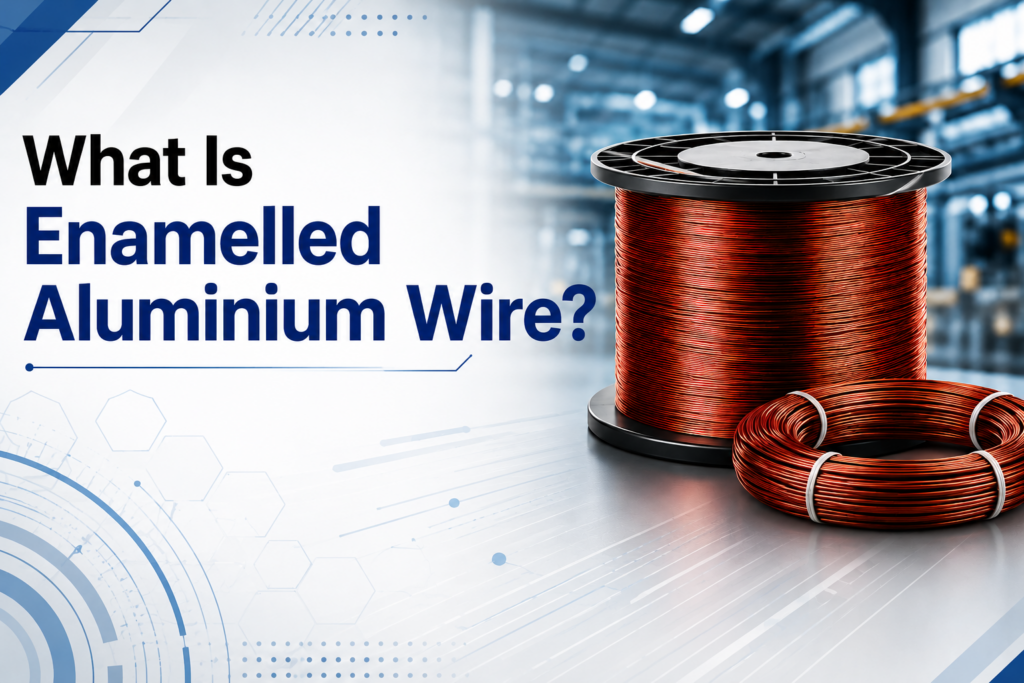
As India’s electrical and power sectors expand rapidly, manufacturers face a critical challenge in finding conductor materials that balance performance, weight, and cost. Enamelled aluminium wire has emerged as the answer, offering reliable conductivity at a fraction of copper’s weight and price.
From distribution transformers and industrial motors to HVAC compressors and household appliances, enamelled aluminium wire now powers equipment across virtually every electrical segment. As leading manufacturers of enamelled aluminium wire in India, we continue to push the boundaries of insulation technology and conductor purity, making aluminium winding wire more dependable than ever.
This guide covers everything you need to know: what enamelled aluminium wire is, how it’s made, its core benefits, where it’s applied, and how to select the right supplier for your requirements.
What Is Enamelled Aluminium Wire?
Enamelled aluminium wire is a high-purity aluminium conductor coated with one or more layers of thermally cured insulating enamel. The enamel layer serves as electrical insulation, eliminating the need for additional insulation sleeves or tapes and allowing the wire to be wound tightly into compact coils.
During manufacturing, high-purity aluminium rod is drawn to precise diameters, cleaned, and then passed through a coating die that applies insulation varnish. The coated wire is cured in a vertical oven at controlled temperatures, typically between 400°C and 550°C, to polymerise the enamel into a tough, flexible film that bonds to the conductor surface.
The result is a lightweight, fully insulated conductor engineered for efficient winding performance and long-term electrical reliability.
Key Properties at a Glance
The table below summarises the core characteristics that make enamelled aluminium wire suitable for demanding electrical applications.
| Property | Detail |
| Electrical Conductivity | ~61% IACS (International Annealed Copper Standard) |
| Density | 2.7 g/cm³ — roughly one-third the weight of copper |
| Dielectric Strength | High — varies by enamel grade and number of coats |
| Thermal Class | Class 130 (B) up to Class 220 (R), depending on insulation type |
| Flexibility | Excellent elongation; withstands tight bending during coil winding |
| Insulation System | Polyester, polyesterimide, polyamide-imide, or composite enamel |
| Corrosion Resistance | Enamel barrier protects against moisture, chemicals, and oxidation |
| Cost Position | Significantly lower material cost per kilogram vs. enamelled copper wire |
Top Benefits of Enamelled Aluminium Wire
1. Significant Weight Reduction
Aluminium’s density is approximately 2.7 g/cm³, compared to copper’s 8.96 g/cm³. That means an aluminium conductor weighs roughly one-third as much as a copper conductor of equivalent current capacity. For transformer, motor, and generator manufacturers, this translates into lighter finished equipment, reduced shipping costs, and easier on-site handling during installation.
2. Lower Material Costs
Aluminium trades at a substantial discount to copper on commodity markets. Because raw materials account for a large share of winding wire costs, switching from copper to aluminium can considerably reduce conductor costs without sacrificing electrical performance when the wire is correctly sized. This cost advantage is especially impactful for high-volume production of distribution transformers and fractional-horsepower motors.
3. Reliable Electrical Performance
While aluminium’s resistivity is higher than copper’s, modern design practices compensate by increasing the conductor cross-section. The result is equivalent current-carrying capability at a lower total weight and cost. Combined with precision-applied enamel insulation, today’s enamelled aluminium wire delivers stable conductivity, low dielectric loss, and dependable performance across thermal cycles.
4. Compact, Efficient Winding
The thin enamel coating, often as little as 15–50 µm per side, maximises the conductor-to-insulation ratio. More turns fit within a given slot or window area, allowing engineers to design smaller, lighter coils or achieve higher turn counts within the same footprint. Both outcomes improve equipment power density and efficiency.
5. Excellent Corrosion Protection
The cured enamel film forms a continuous barrier against moisture, solvents, and atmospheric contaminants. This protection is critical in applications such as submersible pumps, outdoor transformers, and HVAC compressors, where the winding wire is exposed to harsh environmental conditions over decades of service.
6. Sustainability and Recyclability
Aluminium is one of the most widely recycled metals in the world. Using aluminium winding wire supports circular-economy goals by reducing virgin material demand and lowering the embodied carbon of finished electrical equipment, an increasingly important factor as OEMs pursue ESG targets and green procurement standards.
Where Is Enamelled Aluminium Wire Used?
Thanks to its blend of conductivity, lightweight, and cost-effectiveness, enamelled aluminium wire serves a broad range of electrical and electromechanical applications.
Distribution and Power Transformers
Transformer winding is the single largest application for enamelled aluminium wire. Distribution transformers, especially those rated 25 kVA to 2,500 kVA, routinely use aluminium LV (low-voltage) windings to optimise cost. Larger power transformers also adopt aluminium conductors to reduce overall unit weight, simplifying transportation and installation on remote sites.
Electric Motors and Generators
Industrial induction motors, single-phase capacitor motors, submersible pump motors, and standby generators all benefit from aluminium winding wire. The weight savings are particularly valuable in ceiling fans, fractional-horsepower motors, and portable generators, where end-product weight directly affects user experience and logistics.
Pumps, Compressors, and HVAC Systems
Hermetic compressors in air conditioners and refrigerators, as well as centrifugal and submersible pumps, frequently specify enamelled aluminium wire. The enamel’s chemical resistance and aluminium’s weight advantage make it well-suited to sealed, space-constrained motor designs.
Electrical Appliances and Consumer Electronics
From washing-machine motors and induction cooktop coils to solenoid valves and relay coils, enamelled aluminium wire is a staple in everyday electrical products. Its cost efficiency at scale makes it the default winding conductor for many mass-produced appliance platforms.
Renewable Energy Equipment
Wind-turbine generators, solar inverter inductors, and EV charging transformers represent a fast-growing segment for aluminium winding wire. As the renewable energy sector scales, demand for lightweight, cost-effective conductor solutions is expected to accelerate.
Why Manufacturers Are Shifting to Aluminium Winding Wire
Several converging trends are driving wider adoption of enamelled aluminium wire across global electrical manufacturing:
- Cost pressure: Rising copper prices and competitive OEM markets push manufacturers toward lower-cost conductor alternatives.
- Lightweighting targets: Modern industrial design prioritises reduced equipment weight for easier logistics, faster installation, and lower structural support requirements.
- Improved insulation technology: Advances in polyamide-imide and composite enamel systems have enhanced the thermal and mechanical performance of aluminium winding wire to levels that rival those of copper-wound equivalents in many applications.
- Sustainability mandates: Recyclability, lower carbon footprint, and compliance with ESG frameworks make aluminium an attractive material choice for environmentally conscious procurement.
How to Choose the Right Enamelled Aluminium Wire Manufacturer
Not every enamelled aluminium wire delivers the same level of quality. Selecting a reliable manufacturer is essential to achieving consistent winding performance and long equipment life. Evaluate suppliers against the following criteria:
- Aluminium purity: Look for EC-grade (1350 alloy) aluminium with a minimum purity of 99.5% for optimal conductivity.
- Insulation quality and grade: Verify the enamel type (polyester, polyesterimide, polyamide-imide) and confirm the thermal class matches your application’s operating temperature.
- Dimensional accuracy: Tight tolerances on conductor diameter and enamel build are critical for predictable winding counts and slot fill.
- Industry certifications: ISO 9001, BIS (Bureau of Indian Standards), and IEC compliance signal rigorous quality management.
- Technical support: A capable manufacturer provides winding recommendations, enamel selection guidance, and fast response to custom specifications.
- Consistent quality control: In-line testing for breakdown voltage, elongation, flexibility, and adherence ensures every spool meets specification.
Partnering with experienced aluminium wire manufacturers in Mumbai gives you proximity to one of India’s most established winding-wire production hubs, ensuring shorter lead times and access to deep technical expertise.
Frequently Asked Questions
What is the difference between enamelled aluminium wire and enamelled copper wire?
The primary differences are weight, cost, and resistivity. Aluminium weighs roughly one-third as much as copper and costs significantly less per kilogram, but it has a higher electrical resistivity (~2.65 µω·cm vs ~1.72 µω·cm). Engineers compensate by using a larger aluminium cross-section, which still yields a lighter, more cost-effective winding in most transformer and motor designs.
Can enamelled aluminium wire replace copper wire in all applications?
Not universally. Aluminium is ideal where weight savings and cost reduction are priorities, such as distribution transformers, fractional-horsepower motors, and HVAC compressors. For applications demanding the smallest possible conductor size, very high current density, or frequent soldering, copper may remain the better choice.
What thermal classes are available for enamelled aluminium wire?
Common thermal classes range from Class 130 (B) for general-purpose polyester enamel up to Class 200 (N) and Class 220 (R) for high-temperature polyamide-imide or composite coatings. Your choice should align with the equipment’s maximum operating temperature.
Is enamelled aluminium wire suitable for outdoor or harsh environments?
Yes. The cured enamel coating provides robust protection against moisture, chemicals, and UV degradation. For especially demanding environments, such as submersible pumps or coastal installations, selecting a higher-grade enamel and applying additional over-coatings further extends service life.
H2: Why should I source from enamelled aluminium wire manufacturers in India?
India is one of the world’s largest producers and exporters of enamelled winding wire, supported by an extensive aluminium smelting base, competitive costs, and well-established quality certifications (BIS, ISO, IEC). Indian manufacturers offer a strong combination of product range, technical capability, and cost competitiveness.
Conclusion
Enamelled aluminium wire has earned its place as a foundational material in modern electrical manufacturing. Its combination of lightweight, low cost, reliable conductivity, and excellent winding efficiency makes it the conductor of choice for transformers, motors, generators, and a growing list of industrial applications.
As one of India’s trusted enamelled aluminium wire manufacturers and an established name among aluminium wire manufacturers in Mumbai, Jalan Wires delivers high-performance winding wire solutions engineered for reliability, efficiency, and long-term value.
Whether you are manufacturing distribution transformers, industrial motors, HVAC compressors, or specialised electrical equipment, choosing premium-quality enamelled aluminium wire from an experienced manufacturer can significantly enhance your product performance while reducing overall production costs.
Explore Our Full Range of Aluminium Winding Wire Solutions
Visit jalanwires.com to discover why leading electrical manufacturers across India and beyond trust Jalan Wires for their conductor requirements.